Choosing the right Titanium Hexagon Sprocket Nuts requires more than comparing prices or polished product photos. Global buyers need dependable dimensions, verified material grades, accurate threading, and consistent manufacturing records. These nuts often serve demanding assemblies, where low weight, corrosion resistance, and secure fastening matter every day. A small mismatch can create installation delays, uneven loading, or costly replacement work.
This guide examines leading options for international purchasing teams, engineers, and industrial distributors. It considers titanium grade, thread standards, sprocket geometry, surface finish, tensile performance, and supplier quality controls. Practical details matter. A buyer should confirm thread pitch, across-flat measurements, packaging protection, and inspection documents before approving a shipment. Certificates, sample testing, and traceable production records also help establish supplier reliability. Experience shows that reputable manufacturers explain limitations clearly instead of promising universal performance.
No single nut fits every project.
Some titanium alloys offer excellent corrosion resistance but may not suit every high-load application. That tradeoff deserves careful review. Buyers should compare operating temperature, vibration exposure, installation torque, and contact materials before selecting a product. In my view, supplier claims should never replace independent verification. Even a well-machined component can fail when specifications remain vague. This overview aims to support informed decisions through practical comparisons, technical awareness, and realistic purchasing guidance. It also recognizes that delivery consistency can vary between regions, especially when communication is incomplete. Careful questions often reveal more than attractive catalogs.
Titanium Hexagon Sprocket Nuts: Structure, Types, and Key Features
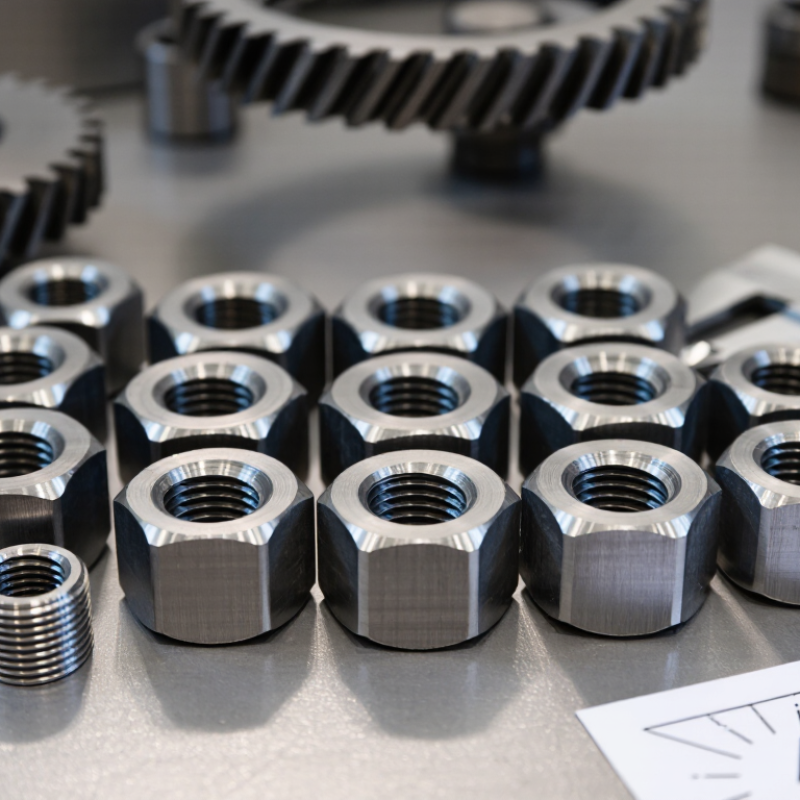
Titanium hexagon sprocket nuts combine a six-sided body with external teeth that help resist rotation. The internal thread carries the clamping load, while the toothed edge grips a mating surface. This structure suits compact assemblies where weight, corrosion resistance, and vibration control matter. The teeth are not a substitute for correct torque.
Common types include plain sprocket nuts, serrated flange nuts, and versions matched to fine or coarse threads. Grade 2 titanium offers good corrosion resistance and ductility. Grade 5 titanium provides higher strength with a slightly greater risk of thread galling. The choice depends on load, temperature, thread size, and contact material. A stainless steel bolt may need careful compatibility checks.
Lightweight matters here. Very much. Titanium can reduce mass in repeated-motion equipment, but its lower stiffness may affect joint behavior. Installers should clean the threads, check pitch with a gauge, and apply a compatible anti-seize compound when specified. Dry tightening can produce unstable torque and damaged threads. I have found that tooth engagement is often overlooked during inspection. It should sit evenly, not touch only one edge.
Buyers should request material certificates, dimensional reports, hardness data, and traceable batch records. Samples should be checked for thread accuracy, burrs, tooth consistency, and surface damage. A nut that looks perfect may still fail a fit test. That small lesson deserves more attention.
| Category | Common Titanium Grade | Typical Chemical Composition | Approx. Density | Key Mechanical or Functional Characteristics | Typical Applications | Buyer Verification Points |
|---|---|---|---|---|---|---|
| Standard hexagon nut | Grade 2 | Commercially pure titanium; titanium content is approximately 98.9% or higher, with controlled oxygen, nitrogen, carbon, hydrogen, iron, and other residual elements. | Approximately 4.51 g/cm³ | Excellent corrosion resistance, good ductility, low magnetic response, and lower strength than alloyed titanium grades. | Marine equipment, chemical-processing assemblies, outdoor structures, and general corrosion-resistant fastening. | Confirm thread standard, dimensional standard, grade certificate, and whether the nut is intended for static or cyclic loading. |
| High-strength hexagon nut | Grade 5 | Ti-6Al-4V; approximately 90% titanium, 6% aluminum, and 4% vanadium by nominal alloy designation. | Approximately 4.43 g/cm³ | High strength-to-weight ratio, good fatigue performance, and strong resistance to many atmospheric and marine environments. | Aerospace hardware, motorsport components, bicycle parts, medical equipment, and weight-sensitive machinery. | Check whether the required condition is annealed or heat-treated and verify compatibility with the mating bolt or stud. |
| Enhanced-corrosion-resistance nut | Grade 7 | Commercially pure titanium with a small palladium addition, generally about 0.12–0.25% palladium depending on the applicable specification. | Approximately 4.51 g/cm³ | Improved resistance in reducing acids and chloride-containing process environments compared with unalloyed titanium. | Chemical-processing equipment, heat exchangers, desalination systems, and aggressive industrial environments. | Request the exact chemical composition and corrosion-environment assessment before selecting this grade. |
| High-temperature service nut | Grade 12 | Ti-0.3Mo-0.8Ni; titanium alloyed with small amounts of molybdenum and nickel. | Approximately 4.54 g/cm³ | Better crevice-corrosion resistance and improved strength in certain elevated-temperature and industrial environments. | Industrial heat exchangers, chemical systems, power-generation equipment, and process piping. | Confirm temperature limits, galvanic compatibility, and the required product standard before ordering. |
| Serrated flange or “sprocket” nut | Grade 2 or Grade 5 | The material chemistry follows the selected titanium grade; the distinguishing feature is the integrated flange and serrated underside. | Approximately 4.43–4.51 g/cm³ | Flange distributes clamping load; serrations help resist rotation during service when used with suitable joint materials and installation conditions. | Compact machinery, vehicle assemblies, frames, brackets, and applications where a separate washer is undesirable. | Check serration geometry, flange diameter, bearing surface, installation torque, and whether the design is reusable. |
| Reduced-head or thin hex nut | Grade 5 | Usually Ti-6Al-4V when low mass and high strength are prioritized. | Approximately 4.43 g/cm³ | Lower profile or reduced mass, but generally less thread engagement and lower load capacity than a full-height nut of the same thread size. | Racing equipment, aerospace subassemblies, lightweight structures, and restricted-clearance applications. | Verify minimum thread engagement, proof-load requirements, wrench size, and resistance to installation damage. |
| Fine-pitch hexagon nut | Grade 5 | Commonly Ti-6Al-4V for high-strength applications; other grades may be specified for corrosion-focused designs. | Approximately 4.43 g/cm³ for Grade 5 | Fine threads provide smaller pitch, improved adjustment control, and greater tensile stress area for a given nominal diameter, but require cleaner alignment. | Precision mechanisms, thin-wall components, vibration-sensitive assemblies, and adjustment hardware. | Specify thread diameter, pitch, tolerance class, mating bolt grade, and anti-seizure treatment. |
| Coated or treated sprocket nut | Grade 5, commonly | Base material is typically Ti-6Al-4V; surface treatment may include a dry-film lubricant, anodic treatment, or another qualified coating. | Approximately 4.43 g/cm³ before coating | Surface treatment can reduce galling risk, improve friction consistency, or provide color identification; performance depends on the qualified process. | Repeated assembly, precision equipment, high-performance vehicles, and applications requiring controlled installation torque. | Ask for coating thickness, friction coefficient, salt-spray or corrosion data, temperature range, and torque-tension test results. |
| Common metric thread range | M4 to M20 | Availability depends on the supplier, manufacturing method, grade, head style, and applicable fastener specification. | Varies with size and grade | Metric coarse pitches are widely used; fine pitches are available for selected sizes and applications. | General machinery, transportation equipment, marine assemblies, and industrial maintenance. | Specify nominal diameter, pitch, thread tolerance, nut height, flange diameter, across-flats dimension, and quantity. |
| Common inch thread range | 1/4 in to 3/4 in | May be produced in commercially pure titanium or Ti-6Al-4V depending on strength, corrosion, and weight requirements. | Varies with size and grade | Unified National Coarse and Unified National Fine thread forms are commonly specified for inch-based systems. | North American machinery, motorsport equipment, marine hardware, and retrofit projects. | State UNC or UNF thread form, class of fit, across-flats dimension, surface condition, and inspection requirements. |
| Manufacturing and inspection | All specified grades | Material should be traceable to a recognized titanium fastener or material specification appropriate to the application. | Not applicable | Cold forming, machining, heat treatment, surface treatment, dimensional inspection, and thread gauging may all affect final performance. | Quality-controlled OEM, export, and safety-related supply chains. | Request material test reports, dimensional inspection records, thread-gauge results, lot traceability, and samples where required. |
| Installation considerations | Grade-dependent | Material and surface condition influence friction, preload accuracy, and galling tendency. | Not applicable | Titanium threads can gall, especially during repeated tightening or at high contact pressure; controlled lubrication and suitable torque procedures are important. | All applications involving titanium-to-titanium or titanium-to-stainless-steel threaded joints. | Define lubricant type, torque coefficient, target preload, tightening speed, reuse policy, and mating-material compatibility. |
FAQS
It has six flat sides and external teeth. The teeth resist rotation against a mating surface. The internal thread carries the clamping load.
Titanium reduces assembly weight and resists corrosion. Its density is about 4.43 grams per cubic centimeter. This helps repeated-motion equipment.
Grade 2 offers good corrosion resistance and ductility. Grade 5 provides much higher strength for vibration and repeated tightening. Grade 5 may gall more easily.
No. The teeth only help resist rotation. Use a calibrated torque wrench and suitable installation guidance. Teeth are not a substitute for preload.
Clean both threads carefully. Apply a compatible anti-seize or dry-film lubricant when specified. Dry tightening can create unstable torque and damaged threads.
Yes. Coatings can improve wear resistance or surface hardness. Their thickness may affect thread fit. Torque should be tested with the selected coating and lubricant.
Check thread diameter, pitch, nut height, and across-flats width. Confirm the thread direction and standard. Do not mix similar-looking thread types.
The teeth should contact the surface evenly. Sharp teeth may damage softer materials. I sometimes overlook one-edge contact, so a second inspection helps.
Request material certificates, dimensional reports, hardness data, and traceable batch records. Inspect samples for burrs, thread accuracy, tooth consistency, and surface damage.
Not necessarily. It may contact the sprocket incorrectly or lack proper clearance. Check washer size, tool access, alignment, and thread engagement during assembly.
Conclusion
Titanium Hexagon Sprocket Nuts combine a hexagonal body with a toothed or serrated locking feature, providing reliable fastening performance in applications exposed to vibration, corrosion, or weight limitations. Their design, titanium grade, and surface treatment directly influence strength, hardness, wear resistance, and long-term stability. Buyers should compare grades according to load, temperature, and environmental requirements, while checking whether coatings or treatments are suitable for the intended assembly conditions.
Before purchasing, carefully confirm dimensions, thread pitch, tolerance, and compatibility with bolts, studs, tools, and mating components. Different industries may require different balance between lightweight construction, corrosion resistance, mechanical strength, and installation security. For global sourcing, purchasers should request clear technical specifications, material certifications, inspection records, sample approval, and consistent quality-control information. Evaluating production capability, communication, packaging, lead time, and after-sales support can also reduce supply risks. A systematic comparison helps buyers select dependable Titanium Hexagon Sprocket Nuts that meet both performance expectations and project requirements.