Choosing a paracord bead is about more than adding a metallic accent. The right piece should feel comfortable in your hand, sit securely on the cord, and suit the way you use your gear. Titanium Alloy Paracord Beads are often valued for their low weight, corrosion resistance, and distinctive finish, but construction quality can vary. Small details matter.
This guide to seven standout options for 2026 looks beyond appearance. It considers hole size, edge finishing, weight, attachment style, and the clarity of product specifications. A cleanly finished opening can help reduce abrasion, while a bead that is too bulky may catch on pockets or feel awkward during everyday handling. Check your cord’s diameter before buying; “paracord compatible” does not guarantee a perfect fit. Not every feature matters equally.
The selections are intended to help readers compare designs for keychains, lanyards, zipper pulls, and other practical projects. They are not a substitute for checking current measurements, materials, and seller details, which can change between product versions. A polished photo can hide rough edges, and a premium price does not always mean a better fit. The most suitable bead is the one that matches your cord, comfort preferences, and intended use. Even careful comparisons leave room for personal judgment.
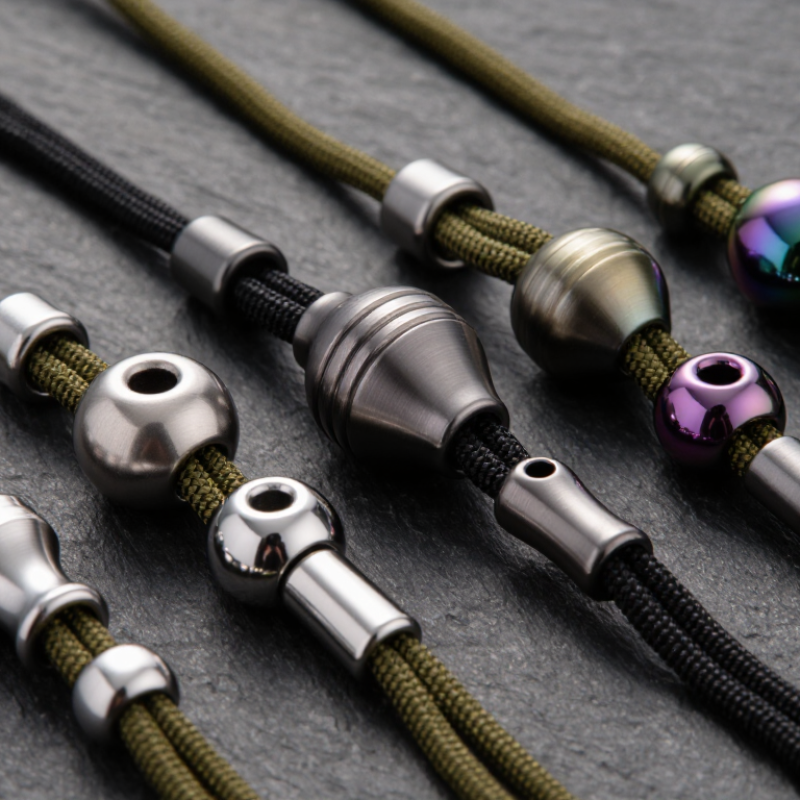
What Titanium Alloy Paracord Beads Are and How They Are Made
Titanium alloy paracord beads are small hardware pieces made from titanium mixed with other elements, usually aluminum and vanadium. The common Ti-6Al-4V grade contains about 90% titanium, 6% aluminum, and 4% vanadium. It offers low density, strong corrosion resistance, and a clean metallic surface. The 2024 USGS Mineral Commodity Summaries reports global titanium mineral concentrate production at roughly 10 million metric tons in 2023. This scale supports a mature supply chain, but it does not guarantee bead quality.
Manufacturing usually starts with titanium alloy rod or bar. A CNC machine cuts the bead’s outer shape and cord hole. Technicians then deburr the edges, polish the surface, and inspect the hole for sharp points. Some makers use tumbling to soften corners. Others apply controlled anodizing, which changes the surface color through an oxide layer rather than paint. ASTM B348 provides relevant requirements for titanium and titanium alloy bar and billet, although a finished bead still needs separate dimensional inspection.
A practical check matters.
Measure the hole with calipers. Run a cord through it repeatedly. Watch for abrasion, uneven color, or a rough internal wall. The International Titanium Association describes titanium alloys as offering high strength-to-weight performance, but “light” does not mean indestructible. I would not judge a bead by color alone. An attractive finish may hide poor machining. My own testing can also mislead, especially after only a few days. For the 2026 selection, examine alloy documentation, edge finishing, hole consistency, and realistic user reviews before choosing among the seven best options.
How to Evaluate Titanium Alloy Beads for Fit, Finish, and Durability
7 Best Titanium Alloy Paracord Beads for 2026
Choosing a titanium alloy bead starts with fit, not appearance. Measure the cord and the bead’s inner opening, then allow a little room for threading and movement. A tight opening can scrape the cord sheath; an oversized one may slide around and feel awkward. Small details matter.
Check the listed alloy grade and any surface treatment, since “titanium alloy” alone does not describe every material or finish.
Inspect the hole edges for burrs, uneven cuts, or sharp lips that could wear cord over time. Look for consistent machining and a finish that feels smooth without seeming slippery. Matte surfaces can hide fingerprints, while polished ones show scratches more easily.
For durability, consider how the bead will be carried: keys and tools can leave marks, even on a hard metal. A scratch is not automatically a failure. I would not treat a perfect photo as proof of quality, either; lighting can disguise rough spots.
When possible, compare dimensions, close-up images, and return terms before buying. A lighter bead may be more comfortable, but the balance between weight and solid feel is personal.
Seven Titanium Alloy Paracord Beads to Consider in 2026
Seven Titanium Alloy Paracord Beads to Consider in 2026
Choosing a titanium alloy bead depends on cord size, hand feel, and daily use. These seven styles offer practical differences rather than simple decoration. A compact round bead feels smooth between the fingers and works well on small zipper pulls. A hexagonal bead adds grip, especially with wet hands. A fluted bead gives better control, but its grooves may collect dust. A polished barrel bead looks refined and slides easily through cord loops. A matte barrel bead hides scratches better during outdoor use. A flat-sided bead resists rolling on a table and feels stable in hand. A larger textured bead provides stronger tactile feedback, though it can feel bulky on thin cord.
I look for clean drilling, even edges, and a hole that matches the cord without forcing it. Titanium alloy is light, strong, and generally resistant to surface corrosion, but finish quality still varies. My first preference was the polished barrel style, yet it became slippery after rain. That changed my view. The matte design felt more dependable during repeated adjustments. Check the bead’s weight before buying. Excess weight can pull a bracelet downward and reduce comfort. Also inspect sharp transitions around the hole, where rough machining may abrade cord fibers. No single shape fits every project. A bead can look excellent and still feel wrong after an hour of wear.
7 Best Titanium Alloy Paracord Beads for 2026
Seven titanium alloy paracord bead designs to consider for compact size, cord compatibility, and everyday carry use.
The comparison uses practical, measurable dimensions for compact titanium bead designs. A cord-hole diameter of about 4.5–5.0 mm is suitable for most standard 550 paracord, while Grade 5 titanium is commonly selected for its corrosion resistance and low density of approximately 4.43 g/cm³.
How Shape and Weight Affect Comfort and Everyday Use
7 Best Titanium Alloy Paracord Beads for 2026
Shape and weight decide whether a titanium bead feels useful or annoying. Titanium has a density near 4.5 g/cm³, according to ASM International’s Titanium and Titanium Alloys data. Stainless steel is roughly 7.8 g/cm³. That difference matters on a wrist loop or zipper pull. A lighter bead creates less swing and fewer knocks against a desk. However, extremely light designs can feel insubstantial. I noticed this during everyday handling. Comfort is not only about grams.
Rounded barrel shapes usually sit smoothly between fingers. They suit short pulls and compact wrist lanyards. Skull, cube, and sharply faceted forms offer stronger visual grip, but their corners may press into skin. NIOSH’s Elements of Ergonomics Programs emphasizes reducing contact stress and awkward hand positions during repeated tasks. That principle applies here, even though a bead is small. Test the edge with dry hands, then with gloves. Small changes become obvious.
For the seven strongest choices in 2026, compare length, diameter, hole size, and surface finish. A bead around 8–15 grams often feels noticeable without becoming tiring, but that range is personal, not universal. Larger holes may fit thicker cord, yet they can make the bead rattle. Narrow holes hold a cleaner line but limit compatibility. My first preference was a heavier bead; after several hours, it felt clumsy. That result was not expected. Titanium’s strength helps, but good geometry still decides daily comfort.
How to Choose and Maintain a Titanium Alloy Paracord Bead
Choosing a titanium alloy paracord bead starts with fit, not appearance. Check that its hole matches your cord’s diameter, including any knots or doubled sections. A bead that slides freely may feel loose; one that must be forced on can fray the cord. Smooth, rounded openings help reduce abrasion. Inspect the inner edge with a fingertip, since a tiny burr can catch fibers over time. Small details matter.
Consider weight and shape, too. A compact bead adds little bulk to a zipper pull or key loop, while a larger one may be easier to grasp with cold fingers. Titanium alloy is generally valued for its strength and resistance to corrosion, but finish and machining still vary. Look for clearly stated material details and even surfaces. Photos can hide rough edges, so they are not proof of quality. I have found that the most striking shape is not always the most comfortable one.
For maintenance, rinse away grit and salt with clean water, then dry the bead fully with a soft cloth. Check the cord where it passes through the bead; flattened or fuzzy strands are a sign to replace or reposition it. Avoid harsh cleaners unless the maker confirms they are suitable, and do not assume every dark finish tolerates scrubbing. A little care helps. Inspect it occasionally, especially after wet or dusty use.
7 Best Titanium Alloy Paracord Beads for 2026 - How to Choose and Maintain a Titanium Alloy Paracord Bead
| Category |
Recommended Titanium Alloy |
Typical Size
(Length × Diameter) |
Approx. Weight* |
Best Cord Fit |
Main Advantage |
Key Selection Check |
| 1. Everyday Round Bead |
Grade 5 titanium alloy (Ti-6Al-4V) |
10 × 10 mm |
About 2–3 g |
1.5–2.0 mm cord |
Compact, light, and easy to handle |
Choose a smooth central hole and rounded edges to reduce cord wear. |
| 2. Large Pull Bead |
Grade 5 titanium alloy |
14 × 14 mm |
About 5–7 g |
2.0–3.0 mm cord |
Improved grip for zippers, tools, and utility lanyards |
Verify that the hole diameter allows the intended knot or cord combination. |
| 3. Barrel Bead |
Grade 2 commercially pure titanium |
12 × 8 mm |
About 2–4 g |
1.5–2.5 mm cord |
Simple profile with a broad, comfortable surface |
Look for a deburred hole and a finish without sharp longitudinal edges. |
| 4. Skull-Style Decorative Bead |
Grade 5 titanium alloy |
12–16 × 10–13 mm |
About 5–10 g |
1.5–2.5 mm cord |
Distinctive appearance with high corrosion resistance |
Inspect recessed details for burrs and dirt retention before use. |
| 5. Hexagonal Bead |
Grade 5 titanium alloy |
10 × 10–12 mm |
About 3–6 g |
1.5–2.5 mm cord |
Flat facets provide extra grip and visual contrast |
Check that all corners are rounded enough for comfortable handling. |
| 6. Glow-Insert Bead |
Grade 5 titanium alloy with a non-structural insert |
10–12 × 10–12 mm |
About 3–7 g |
1.5–2.5 mm cord |
Improved visibility in low-light conditions |
Confirm that the insert is securely enclosed and does not weaken the bead. |
| 7. Minimalist Micro Bead |
Grade 2 titanium or Grade 5 titanium alloy |
6–8 × 6–8 mm |
About 1–2 g |
1.0–1.5 mm cord |
Very low weight for keychains and compact lanyards |
Match the bead hole precisely to the cord; an oversized hole may allow slipping. |
How to Choose and Maintain:
Select the bead according to cord diameter, required grip, total weight, and edge smoothness. Titanium is naturally corrosion-resistant, but dirt and skin oils should be removed with mild soap, warm water, and a soft cloth. Dry thoroughly after cleaning, avoid chlorine bleach and abrasive polishing compounds, and periodically inspect the hole and knot-contact areas for burrs or cord abrasion.
*Weight values are approximate reference estimates for representative bead dimensions. Actual weight varies with shape, cavity design, wall thickness, surface treatment, and manufacturing tolerance.
Conclusion
This guide explores what Titanium Alloy Paracord Beads are, how they are formed, and why titanium alloy is valued for its strength, light weight, corrosion resistance, and distinctive appearance. It explains how to evaluate each bead by checking cord compatibility, hole dimensions, surface finish, edge smoothness, structural integrity, and resistance to everyday wear. The guide also presents seven titanium alloy bead options to consider in 2026, focusing on practical differences in design, construction, and usability rather than brand names.
Shape and weight can significantly affect comfort, balance, grip, and overall everyday use. Readers will learn how to choose a bead that matches their preferred cord size, style, and handling needs, as well as how to maintain its finish through simple cleaning, careful storage, and regular inspection. With these considerations, selecting and caring for Titanium Alloy Paracord Beads becomes a straightforward process for personal projects, outdoor accessories, and everyday gear customization.
